
Young people want to have a say and make a difference. But what is the best way to empower them? A new research from the Generation Europe – The Academy network shows: while youth work professionals often think about framework conditions, young people mainly want two things: practical participation and the right tools for effective advocacy.
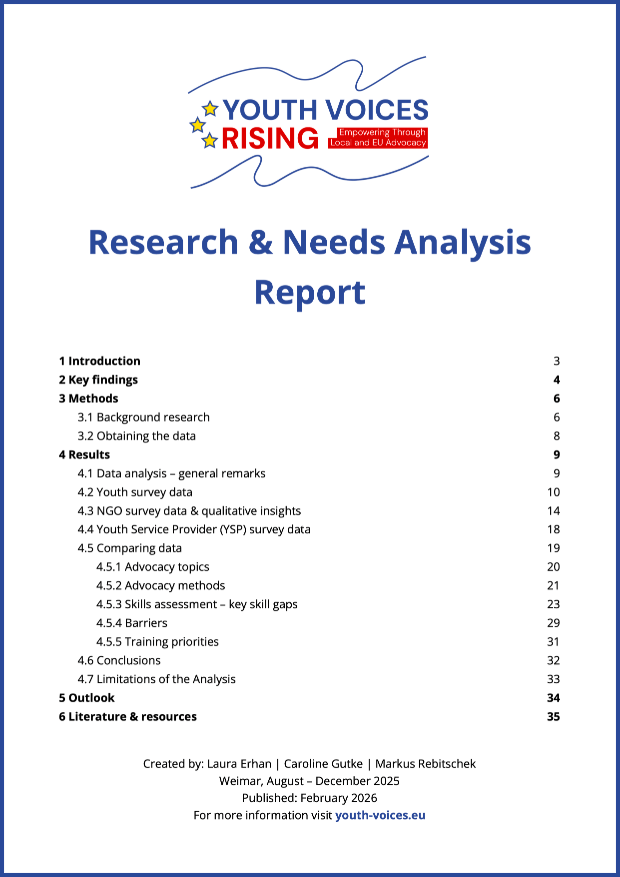
Nine European youth organisations are currently developing these kinds of opportunities together as part of the Erasmus+ cooperation partnership Youth Voices Rising. They have now published a comprehensive needs analysis that forms the foundation for this work.
Three Perspectives for a Better Understanding
Advocacy works best when everyone involved is pulling in the same direction. But do the initiatives offered by organisations always match the wishes of young people? To find out, the team from the European Youth Education and Meeting Centre in Weimar (EJBW) took a deep look. As part of the cooperation partnership, they surveyed not only active young people, but representatives of NGOs and Youth Service Providers from various European countries.
This comprehensive view is important because youth work takes place in a complex ecosystem. The analysis reveals where perceptions agree and where they differ. The central question was: where do we need to start in order to support young people in the best possible way?
Less Theory, More Action
Many young people have a pragmatic desire: “Less Theory, More Action”. They want to learn how to speak confidently in front of groups, how to plan a campaign, and how to meet decision-makers on an equal footing. At the same time, the perspective of the professionals highlights other, equally important hurdles. They often see structural problems, such as a lack of resources and language barriers, which make access difficult. The analysis brings these pieces of the puzzle together: strong structures provided by professionals are needed, filled with methods that strengthen the self-confidence and independence of young people.
From Paper Straight into Action
The results of the analysis have a direct impact on practice. As part of “Youth Voices Rising”, the participating youth organisations have planned an international advocacy training in Thessaloniki and a multiplier training for local lobbyists in Bad Liebenzell. Not only youth work professionals will take part in these, but above all participants from European youth projects themselves. Instead of dry theory, the programme focuses on simulations, public speaking exercises, and direct practical encounters. In the coming months, the young participants of the multiplier training will help to organise local advocacy trainings for youth groups in six European countries (Germany, Italy, Portugal, Hungary, Greece, and Spain).
A Tool for the Community
We are publishing this report to make our working process transparent and to share knowledge. The analysis is an example of how evidence-based youth work can be organised. For instance, the evaluation showed that young people see the topic of educational equality as a top priority for advocacy, while youth work organisations sometimes underestimate this focus among their target group. In addition, the survey results suggest that one of the biggest barriers to engagement is not a lack of interest, but rather the feeling of not being taken seriously by politicians.
We invite everyone active in the field of youth work and civic education to use this data for their own work. The results provide strong arguments for planning new projects and help to convince funders of the need for practical advocacy work. Recently, the policy paper “Young Voices for Youth Work” was also published within the framework of Generation Europe – The Academy, in which young people from nine European countries formulated their common vision for sustainable, well-funded, and inclusive youth work in Europe.
- Youth Voices Rising is a cooperation partnership co-funded by the European Union. More info at: youth-voices.eu
- Generation Europe – The Academy is an international network of youth work organisations and a funding programme for European cooperation. It is coordinated by the International Association for Education and Exchange (IBB e.V.) in Dortmund. The aim is to empower young people to become active European citizens, regardless of their background, parental income, or previous success in the formal education system. More info at: generationeurope.org
Do you want to find out how we turn these findings into concrete actions? Then subscribe to the Generation Europe – The Academy Newsletter to receive regular updates!