
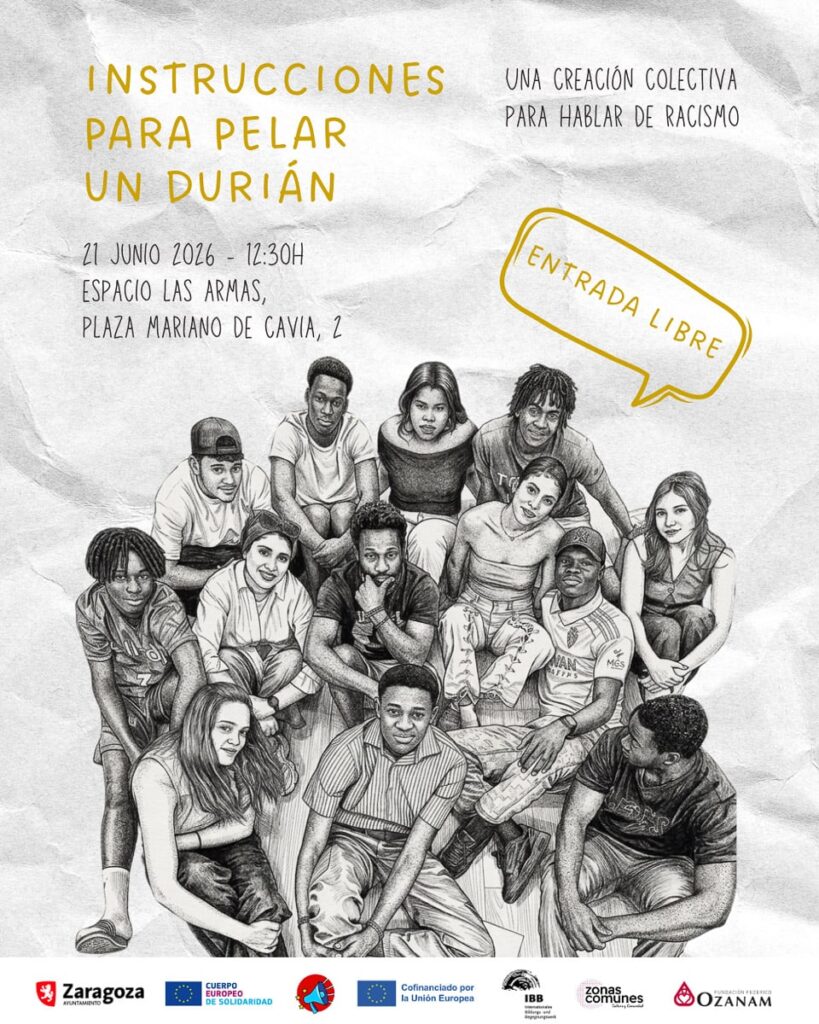
A security guard follows a young person through a shop. Repeated police checks, without any specific reason. A stranger touches someone’s hair without permission. Experiences like these formed the starting point for months of collective theatre work for the local group of Generation Europe – The Academy in Zaragoza, Spain. Eighteen young people developed “Instrucciones para pelar un durián” (Instructions for Peeling a Durian) – a theatre performance about racism, belonging, and the right to tell your own story.
The participants know each other from their school, the Escuela de Segunda Oportunidad. The school is run by the Federico Ozanam Foundation, the local project partner of Generation Europe – The Academy in Zaragoza. The group includes members of ten nationalities, coming from very different backgrounds, religions and places of origin. What many of them have in common are the barriers they face within the formal education system, discrimination and the feeling of being labelled by mainstream society.
The arts collective Zonas Comunes helped to create this safe space and provided methodical support to the young art activists. During weekly meetings and rehearsals, they used physical theatre, writing exercises, poetry and documentary monologues to translate experiences into scenic forms. The aim was not simply to tell stories of victimhood. Instead, they learnt to recognise individual injustices as part of wider social patterns and power dynamics, responding to them with a collective, confident voice.
Turning Experience into Theatre
Some of the scenes grew from personal memories. Others combine situations that the group has observed or discussed. They also looked at moments they had once tried to push aside. Talking about these experiences helped them name unfair treatment as racism. They then decided what they wanted the audience to understand and built a shared script. By chosing what to include and how to show it, they became the authors of the play as well as its performers.
The play also asks who is accepted as part of a city. Even though Zaragoza is their home, some young people are treated as outsiders: They may have to explain where they come from or prove that they belong. Bureaucracy creates additional barriers, when every next step seems to require one more document.
Why a Durian?
The title of the play – Instructions for Peeling a Durian – is a metaphor: the tropical fruit is known for its spiky, uninviting shell. Only those who take the trouble to open it discover its core. The play uses this image to directly criticise racist prejudices: societal judgements are usually based on outward appearances such as skin colour, accent or passport.
In their theatre project, the local group brings to light what all too often remains hidden behind clichés. The participants reveal themselves to be multi-faceted individuals with fuller lives: artistic interests, professional goals, humour, friendships, worries and plans for the future. They refuse to be reduced to their migration status or level of education.

From the Rehearsal Room to Public Action
Working with personal experiences requires trust. The participants needed time to listen, test ideas and decide what they wanted to make public. Regular meetings of their local group gave them that time. It also allowed them to support one another when the material became difficult.
In June, after almost eight months of regular meetings and working together, the time had finally come: the grand premiere took place at Espacio Las Armas, a versatile cultural centre and concert hall in the historic city centre of Zaragoza. The result was a play that provided a forum for discussion and debate about racism in daily life and public institutions, and about identity.
The stage became a venue for social intervention. Using elements of forum theatre, the young people challenged the audience to question their own patterns of perception and to engage in a discussion about living together in an urban community. And it became clear to everyone present: The young people’s lives extend far beyond the labels often used for them.
Local Work in a European Network
The theatre project was developed within Generation Europe – The Academy and as part of an initiative supported by the European Solidarity Corps. Its process reflects several shared approaches of Generation Europe: Young people meet regularly in their communities, identify issues that affect their lives, develop ways to act on them and take their concerns into public space. Experiences that would otherwise often be treated as purely individual or go unheard are transformed into something that can be addressed collectively and shared publicly. The group process combines a safe space with social intervention.
The network connects these local groups and activities across Europe. In August, the young people from Zaragoza will meet with their peers from Germany and Italy, who are also working on local projects, to exchange ideas and support each other.