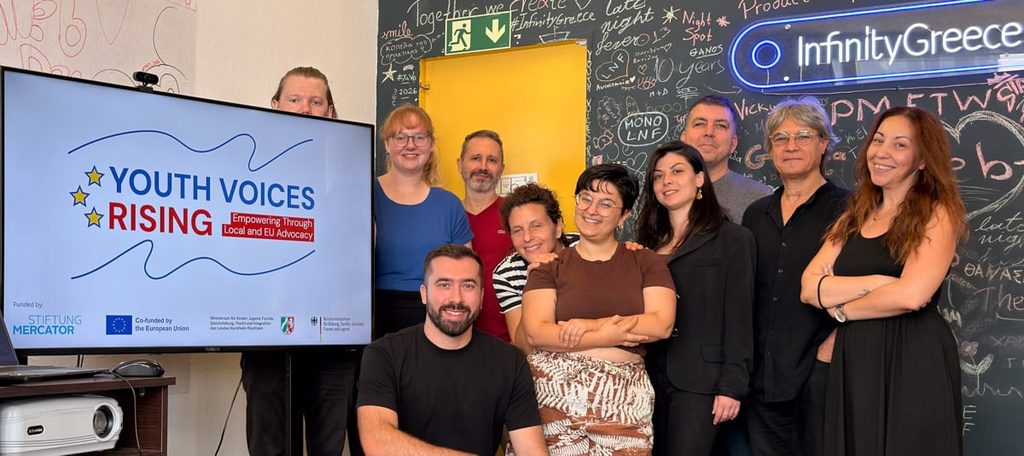
Staying flexible when plans meet the complex reality of youth work: At the fourth International Project Meeting of Youth Voices Rising in Thessaloniki, the nine partner organisations from six countries evaluated their activities since the spring meeting in Budapest. They clarified open financial and logistical questions and adapted upcoming activities to new practical experiences.
The meeting started with a review of the current situation of youth work in the project countries: Germany, Greece, Italy, Portugal, Spain, and Hungary. The participants then connected this general situation to the progress of the Youth Voices Rising project. To involve even more young people with different access needs, the partner organisations shared local experiences and best practices for a broad outreach on the local level.
The team also took a closer look at the follow-up activities to the International Lobbying Training, which took place in Greece earlier this year. Some of the campaign ideas that young people had developed there have not yet been implemented back home. In participatory youth work, this is not unusual, but the consortium wants to use this observation to learn: In interviews with the participants, the partner organisations now want to find out what concrete obstacles slowed down the implementation and how to remove these barriers to youth participation.

Adapting Local Trainings
The reports on the Local Lobbying Trainings that have already taken place showed how important flexible concepts are. The Italian partner organisation Associazione Interculturale NUR from Cagliari presented its experiences with a compact two-day training including an overnight stay. Despite initial communication challenges, the participants successfully completed all modules. By the end, they had three ideas for local actions, two of which they can implement directly.
In Germany, the evaluation of the project’s progress led to a new approach. Originally, the German consortium partners wanted to organise a joint, central training for the young people from all participating local groups. Because this format did not perfectly meet the local needs, the project partners are now working on a new concept. In order to reach the active young people where they already meet, the trainers will now travel directly to the different local groups in Germany and run the trainings as local workshops.

Unusual Local Cooperation
Besides working on project structures, the participants also had time for a study visit to a very special project in Thessaloniki. WE – Action Sports & Culture combines the approaches of a socio-cultural centre, an alternative sports hall, and an open event venue. As a social enterprise experiment, it values close networking with local initiatives, with strategic decisions being made collectively and, where possible, by consensus. Two organisations connected to Generation Europe – The Academy are involved in this: the local partner organisation Kids in Action, which organises non-formal education and creative work with children and young people, and the social cooperative KIRKO – Circus for All, which is part of Youth Voices Rising. Through practical insights into circus pedagogy and direct conversations with the people involved, the project team learned how KIRKO uses circus arts and street theatre for social inclusion, education, and the empowerment of young people.
Virtual Training Sessions in Spring
The main conclusion of the international project meeting in Thessaloniki is this: After a slight delay, the overall project is well on track, and the results so far are impressive. The delegate system of Youth Voices Rising enables active young people to present their positions at professional events and conferences, despite some access barriers. Without this system, their voices might not be heard there. After the consortium already published 30 methods for local and international lobbying this summer, the project experiences so far are also helping to shape the training design of the Social Media for Advocacy Trainings. With these online trainings next spring, the project is opening up even more to the European Community of Practice.

The cooperation partnership Youth Voices Rising is co-funded by the European Union. The views and opinions expressed are those of the authors alone and do not necessarily reflect those of the European Union or the European Education and Culture Executive Agency (EACEA). Neither the European Union nor the EACEA can be held responsible for them.